Best Roof for a Shore House in High Wind: Top Picks
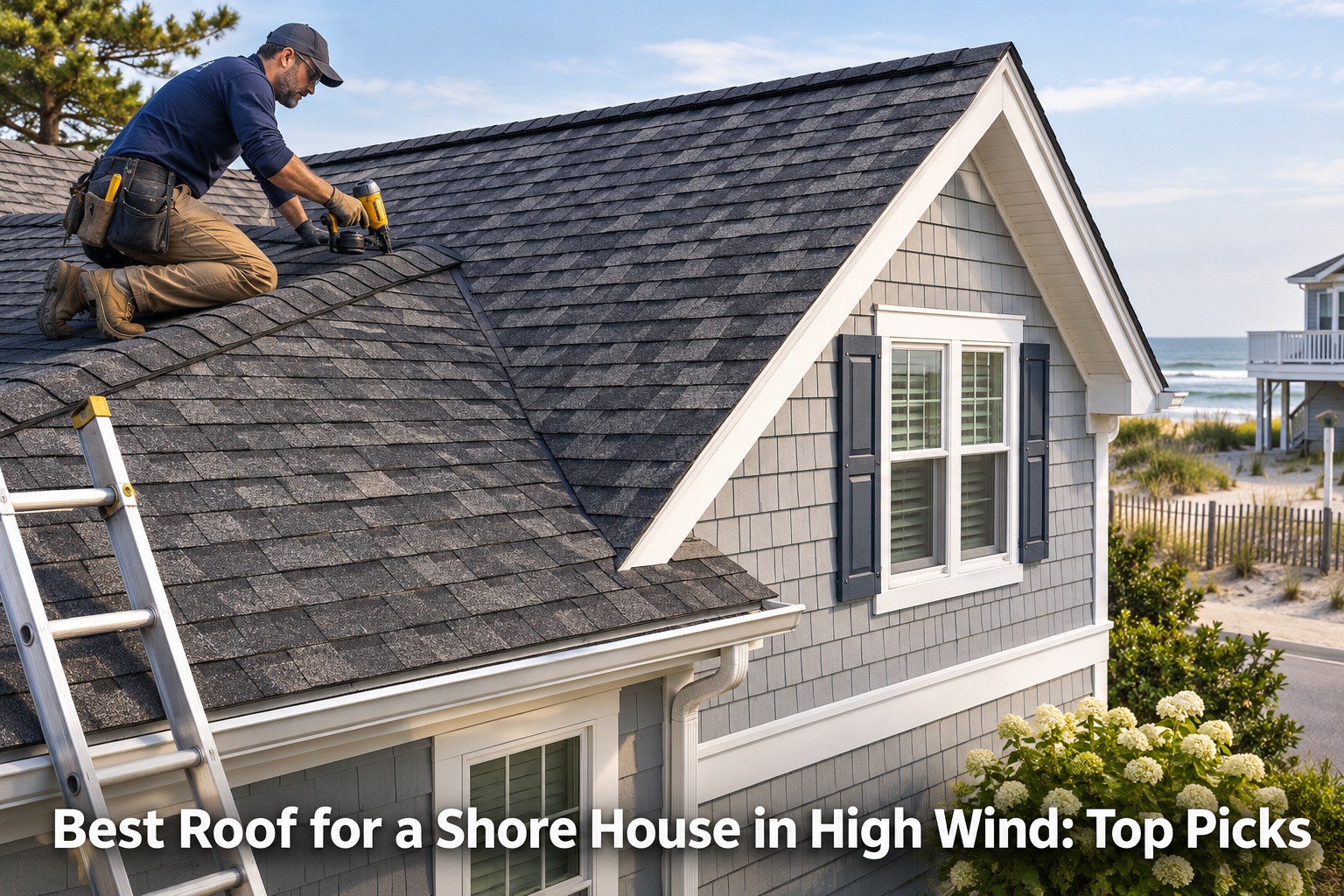
The best roof for a shore house in high wind is a complete system, not a single product name. Shingle, starter course, nails, ridge caps, deck attachment and ventilation all have to work together, and a weak link in any one of them can undo the rest.
Wind ratings are lab results, and warranted wind coverage depends on the current warranty documents and the installation requirements that go with them. No roof prevents all storm damage, because wind-driven rain, flashing failures, damaged decking and falling trees can still cause losses.
Before you sign anything, put these questions to every estimator:
- Which warranty tier applies, and which components does it require?
- How many nails per shingle, and where do they go?
- What starts the eaves and rakes?
- How are the ridge and hip caps fastened?
| System Part | What to Ask |
|---|---|
| Shingle | Which line and which wind coverage? |
| Fastening | Four nails, six nails or ring-shank? |
| Edges | Starter at eaves and rakes? |
| Ridge and hips | Which caps, how nailed and sealed? |
What Actually Makes a Roof Hold Up in High Wind
Wind performance comes from four things working together: the shingle, the fastening, the edges and the deck underneath. A premium shingle nailed too high or started with the wrong strip will still peel at the first strong gust.
No honest contractor can promise a wind number, because the answer depends on how the roof was built, how old it is, the shape of the house and how exposed the lot is. What you can do is choose a system whose manufacturer sets clear installation requirements, then make sure every one of them is followed.
Here is where wind damage usually starts:
- Unsealed shingles that never bonded to the course below
- Nails driven high on the shingle or only partly seated
- Edges at the eaves and rakes where wind gets underneath
- Ridge and hip caps that were face-nailed or poorly secured
- Decking that has softened or delaminated and no longer holds a nail
Shingles are most vulnerable to blow-off before thermal sealing occurs. A roof installed in cold weather, or one that never saw enough sun to activate the sealant, can be at more risk than the same roof a few weeks later.
Wind Classifications Versus Warranted Wind Coverage
Asphalt shingles commonly carry ASTM D3161 Class F and ASTM D7158 Class H wind classifications. These are standardized lab classifications, not the same thing as a manufacturer’s warranted wind coverage, which varies by product and depends on installation requirements.
Owens Corning wind warranty tiers tie directly to how the roof is installed:
- 110 mph coverage with a four-nail application
- 130 mph coverage that may require a six-nail application, per the installation instructions
- Eligibility up to 160 mph on Duration Series when required system components and starter shingles on both eaves and rakes are used
A marketed speed is not a performance guarantee, and a limited lifetime warranty does not mean the roof is covered for every wind event forever. Wind-damage coverage is subject to the warranty terms and time limits, so read the current documents.
Nailing, Starter Courses and Deck Attachment
Follow the manufacturer’s installation instructions for the product and the warranty tier you want. Four nails is the baseline for the 110 mph tier, while six nails may be required for 130 mph coverage.
Starter shingles matter just as much. For maximum wind warranty on Oakridge shingles, Owens Corning requires Starter Strip Plus along both the eaves and the rakes, not just the eaves.
Deck attachment is the next layer down. The FORTIFIED Roof approach uses ring-shank nails installed in a specified pattern to improve how the roof deck is held to the framing. Ask your estimator whether that kind of deck fastening fits your project.
Roof Shape and Edge Details for Shore Exposure
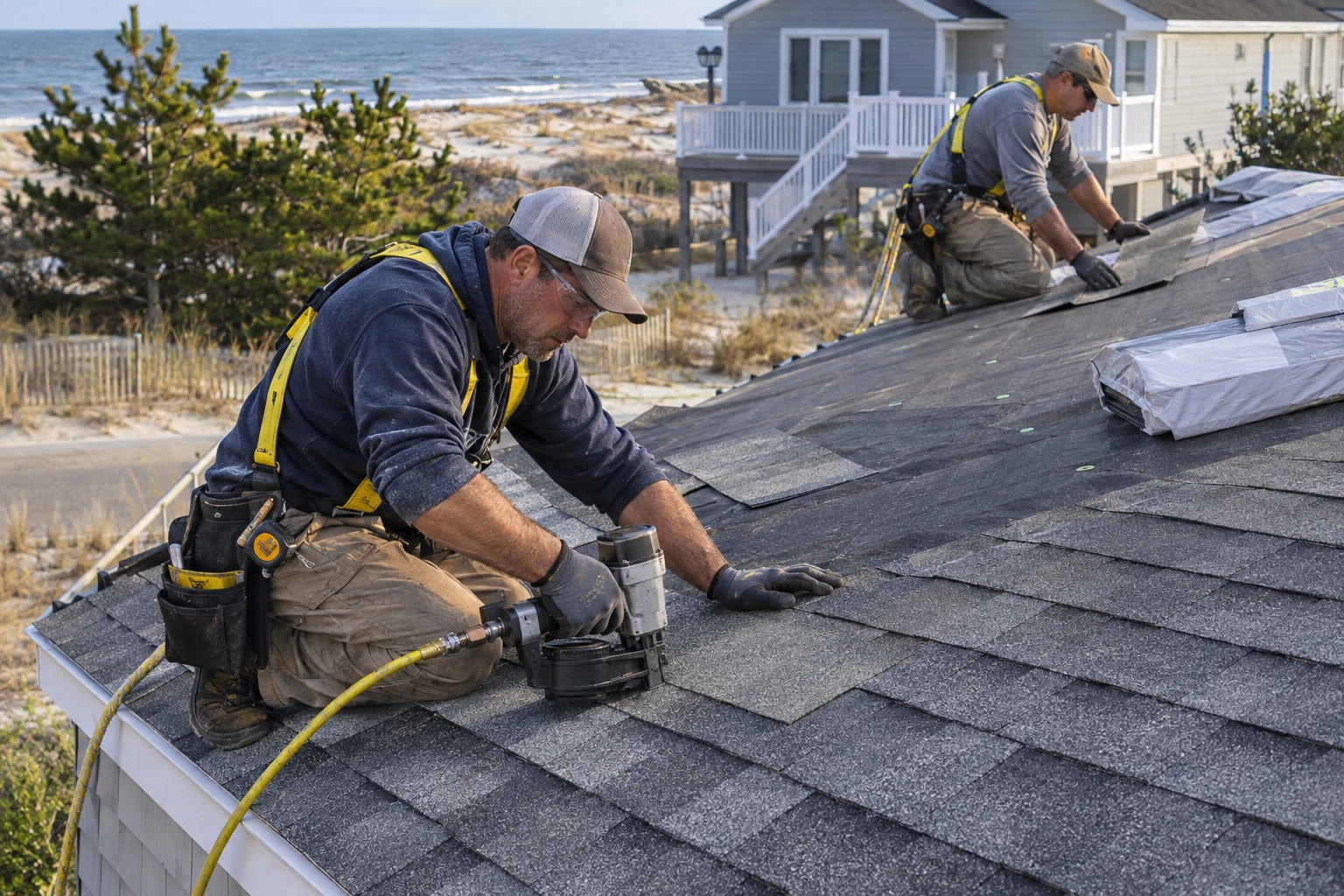
Roof geometry does affect wind vulnerability, but it is one input among several, not a verdict by itself. On the shore, exposure compounds the question: a house on a bay block takes wind differently than one on a beach block, and a taller raised house sits higher in the airflow than a low ranch.
Shape tells you where the risk concentrates. Details tell you whether the roof can handle it. Whatever the shape, ask your estimator to walk the roof edges with you, because that is where the work either holds or fails.
Hip Roofs, Gable Roofs and Overhangs
Owens Corning notes that four-sided hip roofs are more aerodynamic and resistant to wind damage, while gable roofs with wide overhangs are more susceptible to uplift.
That does not make a gable roof a bad choice. A gable house with deep overhangs needs extra attention at the rakes, with proper starter shingles and secure edge fastening. A hip roof with poor ridge work can still fail.
Ridge, Hip and Rake Details Where Wind Lifts a Roof First
The roof edge is especially vulnerable in high wind, and ridges and hips are close behind. Wind that gets under a loose cap or rake edge can start peeling a roof from the top.
For Owens Corning high-wind hip-and-ridge installation, the requirement is four nails per shingle and hand sealing to maintain the 130 mph wind warranty. Ask your estimator these questions:
- Which ridge cap product will be used?
- How many nails go in each cap, and where?
- Will the caps be hand sealed?
Owens Corning Shingle Lines for High-Wind Coastal Homes
The best roof is the one installed to the full system requirements for your exposure. Owens Corning offers several asphalt shingle lines, and the homeowner chooses with the estimator, based on the house and the site. Architectural shingles can be part of a high-wind system, but classifications, warranty terms and installation requirements vary by product. A shingle’s name alone settles nothing.
- Duration Series: eligible for wind-resistance warranty coverage up to 160 mph when required Total Protection Roofing System components and starter shingles on both eaves and rakes are used.
- Oakridge: requires Starter Strip Plus along both eaves and rakes for maximum wind warranty.
- Other lines: Owens Corning offers additional shingle tiers, including designer and flexible options, each with its own installation and warranty documents.
Duration shingles feature a SureNail strip, a fastening feature designed to help hold the nail in place. Owens Corning’s own pages also cite storm-tested field results. Treat those as the manufacturer’s evidence, and ask to see the warranty documents that apply to your roof.
Matching a Product Line to Your Home’s Exposure
Choose a tier by site conditions, not by name. Weigh these factors with your estimator:
- How exposed the lot is to open bay or ocean wind
- Roof shape, overhang depth and edge length
- Budget and how long you plan to own the home
- Appearance, including color and wood-shake looks
Appearance narrows which lines you can choose from, since some offer wood-shake styling and others focus on color range. Settle the wind coverage you need first, then see which lines offer the look you want.
Impact-Resistant Shingles and High-Wind Ratings
Class 4 impact resistance addresses hail, not wind. Not all impact-resistant shingles are equally suited to coastal wind, so check the wind classification and warranty terms separately.
Confirm any homeowners-insurance discount requirements with your contractor and your insurance company. No discount or FORTIFIED designation is promised by the roof alone.
What Crews Typically Find When Tearing Off a Cheaply Installed Roof
These are common findings on tear-offs, not a count or a claim about any one company’s jobs. Each one ties back to wind performance:
- Missing or wrong starter strip at eaves and rakes: edges lose the bond they depend on.
- Mismatched or nailed-through ridge caps: the highest point of the roof lifts first.
- Too few or high nails: shingles hold by adhesive alone and tear free in gusts.
- No ice and water barrier at eaves and valleys: wind-driven rain finds the gaps.
- Reused or face-nailed flashing: a leak path that wind pushes water into.
- Blocked or missing intake ventilation: trapped heat ages the shingles and weakens the sealant.
- Layered-over old shingles: new shingles sit on an uneven base and hold poorly.
- Soft or delaminated decking: nails have nothing solid to grip.
A roof can look fine from the street and still hide most of these problems. That is why tear-off, deck inspection and detail work matter as much as the shingle.
How This Decision Plays Out Along the South Jersey Shore
Absecon Island and the Downbeach towns of Margate, Ventnor and Longport take wind and salt from the ocean and the bays, so a roof here works harder than one inland.
Many homes built in the 1980s through the 2000s, especially in Egg Harbor Township and Galloway subdivisions, still wear their original builder three-tab shingles, and those roofs are aging on the same clock. Mainland homes near the bays, including parts of Absecon and Pleasantville, still see bayside salt and nor’easter exposure.
That makes the high-wind spec worth considering even when the house is not on the beach block. Neighbors who were roofed together tend to need replacement together, which is a good moment to upgrade the system rather than repeat it.
Salt Air, Fasteners and Flashing on Barrier Islands
On Brigantine, Margate, Ventnor, Longport, Ocean City and Sea Isle, salt arrives from two or three sides and corrodes fasteners and flashing. A roof that holds on paper can fail from the inside out.
Ask for this spec: high-wind shingles, a sealed starter course, stainless or coated fasteners and coastal-grade hardware.
Nor’easters, Flood Hazard Areas and Permits
Nor’easters funnel up the bays, and salt reaches mainland areas near the water more than owners expect, including Absecon, Pleasantville along Lakes Bay, and bayside parts of Egg Harbor Township and Galloway.
Flood hazard areas can require a floodplain development permit even for a like-for-like roof replacement. Brigantine runs roof work through that process, so confirm with your local building department before scheduling.
For raised and post-Sandy rebuilds, use flood-resistant materials below the flood line and membrane on low-slope deck roofs.
What Drives the Cost of a High-Wind Roof
Cost follows the job, not a single number. These factors move the price:
- Roof size and pitch
- The number of layers to remove
- The material and shingle line you choose
- Access to the house and the work area
- Decking repair needs found at tear-off
Wind warranties may require specific starters, ridge caps and a higher nail count, and each one adds materials and labor. Pricing a roof without seeing it is guesswork.
How Legacy Exteriors Installs a High-Wind Roof
Legacy Exteriors installs roofs with its own crews, under NJ HIC #13VH14270500 and PA HIC #PA223754. The process follows a clear order:
- Inspection and deck evaluation
- Tear-off to the deck
- Edge and starter details at eaves and rakes
- Fastening to manufacturer instructions
- Ridge and hip installation
- Ventilation and flashing
- Final check
Emergency roof repair is available for storm damage, and financing is offered for larger projects. Ask your estimator which warranty documents apply to your roof, and have them show you the requirements in writing.
Conclusion
The best roof for a shore house in high wind starts with the whole system: the shingle, the fastening, the edges, the roof shape, the ventilation and the local conditions of salt, nor’easters and flood zones. A strong product installed carelessly will not perform, and a careful install of the right components will.
Pick your questions, walk the roof with the estimator and read the warranty documents before you commit. Your next step is simple: gather your questions and compare how each estimate answers them.
Ready for a straight answer on your own roof? Call Legacy Exteriors at (609) 623-5523 or request a free estimate and we will take a look.
Frequently Asked Questions
What is the best roof for a shore house in high wind?
It is a complete system installed to the manufacturer’s requirements for your exposure. Shingle line, starters, nails, ridge caps, deck attachment and ventilation all count. Compare the warranty documents that apply to each.
Are architectural shingles good enough for a South Jersey beach house?
They can be, when installed as part of a high-wind system. Classifications, warranty terms and installation requirements vary by product, so check the specific line and its documents.
Does a hip roof hold up better than a gable roof in a hurricane?
Four-sided hip roofs are more aerodynamic, while gable roofs with wide overhangs are more susceptible to uplift. Shape is one factor, and edge details and fastening matter just as much.
How many nails should be used on shingles for high-wind protection?
Follow the manufacturer’s installation instructions. Four nails is the standard for the 110 mph tier, and 130 mph coverage may require six. Ridge and hip caps need four nails per shingle and hand sealing to maintain 130 mph coverage.
Will a high-wind roof qualify for a homeowners-insurance discount? Confirm requirements with your contractor and your insurance company, since no discount is promised.